Sunflower Fields of Donetsk

¥1,000 (with Tax)

Explanation

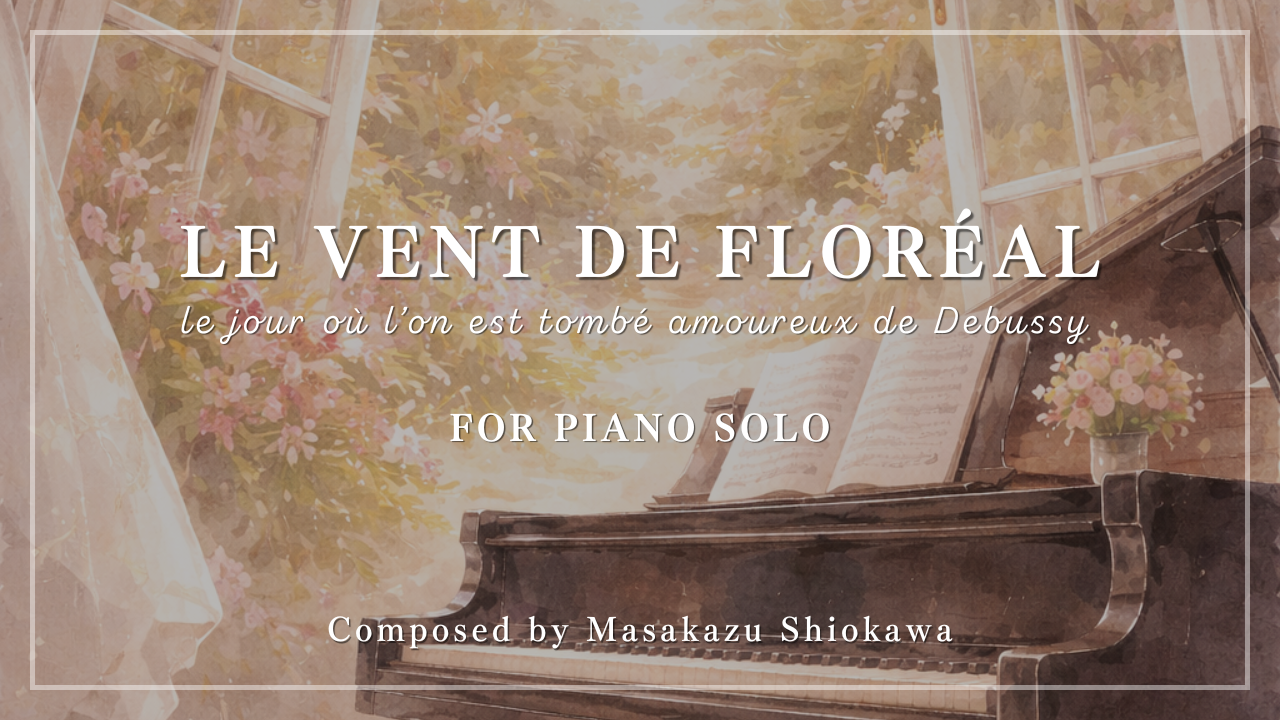
The title means “The Wind of Floréal — Falling in Love with Debussy.” This is a new piece from Sketches of Seasons and Scenes, a collection of short works written around the theme of “atmospheric pieces for pianists with small hands who cannot comfortably reach octave double notes.” 
As of March 2026, when this work was completed, the war between Ukraine and Russia that began in February 2022 shows no sign of ending and has become increasingly protracted. While the Russian forces initially advanced as the invading side, the years that followed have seen increasingly effective counterattacks by Ukrainian forces, resulting in an enormous loss of human life. Against the backdrop of this ongoing tragedy, this piece focuses on the imagined story of a single soldier. 
The duration is just under five minutes. Throughout the piece, a low ostinato in the left hand underpins a wavering melodic line on the right. From the middle section onward, tension gradually increases using chromatic motion and the tritone—the so-called “devil’s interval.” In the later section, the main theme gains weight through chordal writing, raising the technical demands somewhat; however, toward the conclusion the theme returns in a single melodic line, passing by and fading away like scenes in a lantern of memories. At the very end, the piece quotes the national anthem of the former superpower, the Soviet Union, bringing the music to a close in an atmosphere of despair. 
As an epigraph, I quote words reportedly spoken by a Ukrainian woman to Russian soldiers who had advanced into Kherson Oblast in the early days of the war: 
“Take these seeds and put them in your pockets, so that at least sunflowers will grow when you lie down here.” 
This remark attracted widespread attention in the media as a symbol of the stark difference in perception between Russian soldiers—some of whom believed they were carrying out a military operation to liberate Ukrainian civilians from oppression—and the Ukrainian civilians themselves. 
We do not know what became of the soldier who might have taken those seeds. Today, however, along the front lines in places such as Donetsk Oblast—now among the fiercest battlegrounds—more than thirty thousand people are killed or wounded each month. It is not impossible that, as the woman’s words suggested, plants may one day grow from the soil where fallen soldiers have returned to the earth. 
Even if those flowers are sunflowers, whose symbolic meaning is love, how should we look upon them? 

Composer:Masakazu Shiokawa

Arranger:Masakazu Shiokawa

Sheet type:PDF

User Guide

Price

1,000円(税込)

Duplication (e.g. copying electronic files containing music)

Performances (e.g., playing in a concert hall)

Public publishment (e.g. uploading music to a website)

Transfer: Transferring the original or a copy of a work to make it available to the public
(e.g., selling the CD of this music)

×

Lending: Lending copies of copyrighted works to the public
(e.g., lending the CD of this music)

×

Arrangement

×

Adaptation (e.g., sampling part of a piece of music and incorporating it into another piece)

×

Additional information

Price

有料

楽譜の有無

楽譜あり

音源の有無

音源あり

楽譜形態

ダウンロード楽譜

Reviews

There are no reviews yet.

Be the first to review “ドネツクの向日葵畑”